The poet's notebook opened to the blank page.

7 Essential Tips for Young Poets on Finding the Poem


You love poetry. That’s where we all begin – love of a good poem. Now, it’s time to write your own poems. But you hate what you’ve written. Now what?

1. Free Writing

After you’ve picked an interesting starting point for your poem, which can be as simple as the tree in your front yard, start writing. Write the good, write the bad, write what comes into your head. Soon, with practice, you’ll follow the path from something mundane to something interesting. Keep writing. Even after you think you’re done, keep writing. Magic can happen here and often does. It’s a bit of stream of consciousness, it’s a bit of free association, and it’s a bit of triggering the subsconscious. When you do finish, you’re not finished. See tip number seven.

2. Research

Find a topic that interests you and dive into the research. Whales? The violent crime rate? Farming techniques in the middle ages? Take notes. Learn your topic, so that when you do begin writing your poem, you have a feel for what it is you’re exploring. Although I often take copious notes during my research phase, I rarely use all of my research. It’s a jumping off point. It helps me understand the world that I’m writing about. And when I’m writing, I lean in to what I sense is important or interesting or needed in the poem. But doing your research can so often lend a texture to your poetry that you cannot get without it. It’s not essential, but it can make for rich details and bring your audience into a world that they had not yet explored.

3. Observe

So much good poetry centers around intense observation. Whatever it is you’re writing about, strive to really see it, and see it from all angles. Strip away your biases. Open those peepers and take it all in. Empathize. Observe. Write it all down. Then see tip number seven.

4. The Senses

While a poem does not often rest wholly in the physical realm, I believe it must be grounded there. We experience the world through our senses first. Use them. Most good poets are excellent at painting a strong visual image. But you can go beyond that with descriptions of taste, touch, sound and scent. Scent is such a powerful emotional tool. We connect to scent in subconcious ways that can trigger all kinds of feelings. Don’t underestimate the power of all five senses in your poem. That’s not to say you need to hit every sense in every poem, but only that you should be aware of your full arsenal of language and connection.

5. Metaphor

Oh the metaphor, sweet, sweet metaphor. Don’t let your poems idle in neutral with a single image. Complicate the idea in your poem, explore it, expand it with metaphor. Consider extending your metaphor across the whole poem, or use multiple metaphors to bring out your image/idea and make it feel more connected to the world at large.

6. Get Weird

Please don’t be normal. Writers with normal sensibilities should write essays or stories. (I kid! Sort of.) But in all seriousness, when you are writing poetry, let your mind and imagination take you to weird places. Make strange, and almost non-sensical, connections. You won’t keep every weird tangeant in your poem. But fortunately, it can all be made wonderful with tip number seven.

7. Edit

Once you’ve let your pen run rampant across the page, let it mellow for a day then return. What feels interesting, moving, powerful? As the poet, you get to establish your own criteria for what you think is important. But do have a yardstick. And then start shaping that poem. Yes, we’re cutting words out. But we’re also looking for opportunities to reshape and add to the poem as well. This is not to say that there are no great poems that come out fully baked and ready for publishing. But so much of the best poetry out there has been edited and re-edited. Editing allows us to take the fresh eyes of a new day and hone our poem until it shines. Mary Oliver once said, “In my own work, I usually revise through forty or fifty drafts of a poem before I begin to feel content with it.” Ama Codje writes, “Time is the first ingredient of my approach to revision; it allows me to re-see much more clearly than I’m able to immediately after I’ve drafted a poem.”1 And of Anne Sexton, the The New Your Times wrote, “It is instructive to learn, for instance, that at certain periods in her life she revised endlessly, taking a poem through 20 or more drafts, while at other periods she wrote in a kind of white heat, two, three, even four poems a day.”2

As you train your measuring tools for what is good poetry in your writing, you’ll get better and better at knowing when a poem is truly done. Or at least done enough. Walt Whitman famously never stopped editing Leaves of Grass. No pressure.

1https://www.ironhorsereview.com/single-post/7-contemporary-poets-on-revision

2https://www.nytimes.com/1981/10/18/books/the-rise-and-fall-of-a-poet.html

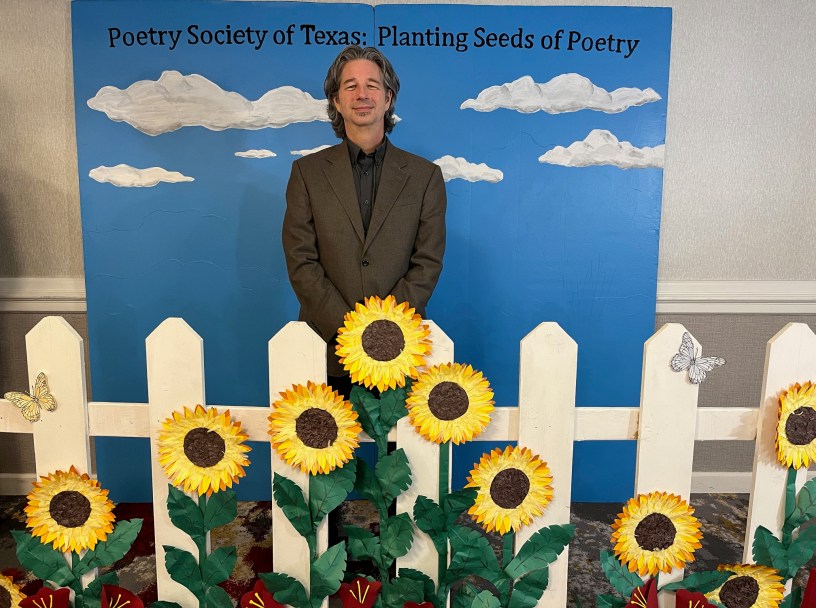
PST Summer Conference 2025 Poetry Workshop by Corbett Buchly on Ambiguity in Poetry

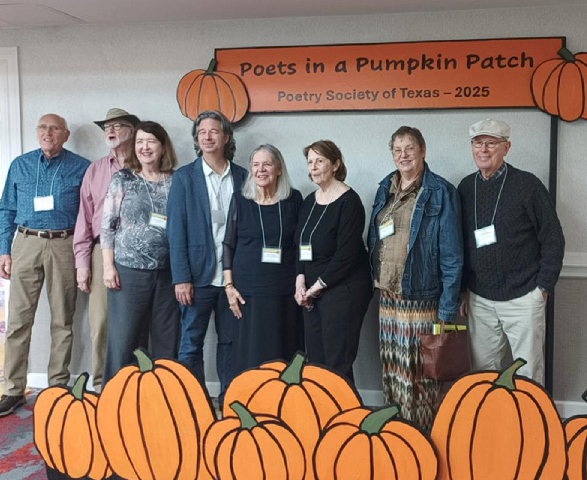
Poetry Society of Texas Summer Conference 2025

I attended my first Poetry Society of Texas (PST) Summer Conference this year, and it was a great experience. Possibly my favorite part was in between sessions getting to meet poets from all around the state, mostly from DFW, Tyler and Houston, but I’m curious if there were poets from some of our other chapters there too. Being involved in an interest-focused community is everything, from the sharing of ideas (publishing, techniques, favorite authors, etc.) to the general commiseration around being an artist.

I’ve been a member of the Poetry Society of Texas and the Denton Poetry Assembly (chapter) for two years now. Since the conference was held in Denton, my chapter hosted it. Late last year, I was invited to run a short poetry workshop for it. I said, “of course!” because I tend to say “yes” to things. And then I promptly came home and asked myself, “Now, what topic am I going to deliver a workshop about?” But as I looked through my notes, and the books that I’ve tabbed, and I thought about my own poetry goals and philosophy, the arrow really began pointing toward this idea of ambiguity in poetry. I was able to pull in perspectives and poems from a variety of sources to assemble a lecture and workshop. I was really happy with the result, and got some great feedback from the participants afterward. The full title of my workshop was “Balancing the Concrete and the Ambiguous.”

At any rate, I look forward to attending another PST summer conference and renewing friendships and diving back into that poetry community.

John Corbett's character Chris Stevens reading literature on Northern Exposure

The Literary Allusions in Northern Exposure

Recently, I have been rewatching Northern Exposure. Yes, this TV series is over 30 years old, but the series has a particular nostalgia for me. Often while watching the show with my mother, one of the characters, often John Corbett’s Chris Stevens, would make a literary reference. And I would point to my corner bookshelves and say, “Yeah, I’ve got that book over there.” It’s like they had my home library for reference. It has been a little uncanny. Which of course, endeared me to the series even more. I by no means have a comprehensive library, but whoever was writing for the show had gravitated toward many of the same classics I had. I detect the machinations of a cultural zeitgeist at work.

The one reference that inspired me to write this blog was to a work I had not read, “Remembrance of Things Past” by Marcel Proust. It was such a beautiful passage though, I felt compelled to pick up the novel (the first in a series). Corbett’s DJ character read this one on the air:

When from a long distant past nothing persists, after the people are dead, after things are broken and scattered, still alone, more persistent, more faithful, the smell and taste of things remain poised a long, long time like souls, ready to remind us, waiting, hoping for their moment amid the ruins of all the rest, and bear unfaltering in the tiny and almost impalpable drop of their essence the vast structure of recollection.

Certainly, speech patterns change over time, but I found this prose so lyrical as to be magical. I found myself wondering if writing like this gets weeded out these days as too alienating to readers, or if it simply isn’t written.

The Chris Stevens character has a meandering, philosophical and well-educated style of pontification, which he delivers mostly over the radio, but also to fellow members of the town as a kind of defacto psychiatrist. I delight in the intellectual inquisitive nature of the dialogue that I haven’t found anywhere else.

Here’s a short list of literary references I know of made on the show that occupy space on my library shelves:

Zen and the Art of Motorcycle Maintenance, Robert M. Pirsig

In Dreams Begin Responsibility, Delmore Schwartz

Plays of William Shakespeare (The Tempest)

Leaves of Grass/Song of Myself, Walt Whitman

On Walden, Henry David Thoreau

The Stranger, Albert Camus

The Call of the Wild, Jack London

The Power of Myth + The Hero With a Thousand Faces, Joseph Campbell

The Raven, Edgar Allan Poe

Other authors mentioned include: Fyodor Dostoevsky, Franz Kafka, Carl G. Jung, William Wordsworth, Edna St. Vincent Millay, Friedrich Nietzsche, Herman Melville and Emily Dickinson.

What fun!

Why Poetry Matters

Recently a friend of mine who teaches high school English asked me if I had anything to say to high school freshmen about why poetry matters. Well, wow. That’s the $100 question, isn’t it? I had to have a think about that one.

I do think it matters, of course, but my guess is that a lot of people never look at another poem after leaving high school. Maybe I’m wrong. I hope I’m wrong. According to a 2022 NEA study those U.S. adults who read one or more books in a year slipped from 55% in 2012 to 49% in 2022. That same study, however, showed that the percentage of U.S. adults reading poetry actually increased to 9% in 2022 from 7% in 2012.

Here’s Ethan Hawke’s optimistic view of why poetry matters. A beautiful sentiment, elegantly said.

But for me, first and foremost, I just really, really like poetry. I have often said (and had no one agree with me) that poetry is the highest art form. It incorporates language, intellect, emotion, various aesthetics, rhythm, the body. There’s so many worthwhile things going on in a well-crafted poem.

I’m sure you know poetry most likely predates written language, as it was passed down through oral tradition, from generation to generation. Not only did it preserve cultures, but it strengthened communities. Many of the techniques we still use like rhyme and meter made poetry easier to remember.

I believe there’s something at work in the body when we read and respond to poetry. It can be a very physical experience (like music, with which it has a lot of shared qualities). But at the same time, we are stimulating the mind, challenging assumptions, and opening up new ideas.

Some of modern poetry can definitely be challenging, and it scares people away. I blame that on how the critics first responded to T.S. Eliot’s work, which I think was intentionally obfuscating (while not maliciously so, of course). But there is plenty of modern poetry being written that is accessible by the non-initiated (real poetry, I mean, and not Instagram poetry).

Students should know that when they find a poem that they like, they should always read it aloud. It’s the best way to experience poetry. You want to feel the poem in the mouth and in the sound in the air. You want to hear the poem in its intended rhythms and sounds. Or you can lose much of the art that makes a particular poem work.

Students should also know it’s okay not to fully understand the poem. That’s right! Poems are meant to be experienced. One should ask themselves first how a poem makes them feel, not what it means. I listen to so many rock songs that lift my spirits, but for which I cannot decipher all of the lyrics.

So let the poem wash over you. Poetry is usually a quiet affair, read in a quiet space in a quiet voice, allowing the mind and body to quieten and simply welcome in the poem. Doesn’t that slowing down and experiencing good art seem worthwhile?

Poetry matters in the way that any good art can matter. It can move you or change you or illuminate a truth or an understanding – in a way that other things can’t fully reach or in places to which they cannot fully connect. Or it can simply offer the reader a pleasant movement in an otherwise hectic world.

The Poetry Society of Texas Annual Awards Banquet 2024 – Poets & Poems

I was lucky enough to attend the Poetry Society of Texas Annual Awards Banquet again this year. It’s a lot of fun chatting with other Texas poets and hearing most of the wining poems being read. I was more than happy to take home three awards this year for my poems “ring” (that explores the symbolism of the wedding ring), “two towers twenty-three years” (about 9/11), and “the film” (about the movies, of course!) While 98% of the poems I send out to journals and contests were written in the last five years, I have a few still strong poems from my graduate days that I include. “The film” is one of those few poems. So happy to have it rewarded! It really reinforces the idea that there is an audience out there for all good art. Often you just have to find the right one.

50th Published Poem: Milestone Reached

I’m so happy to announce that my 50th poem was accepted for publication. What a huge milestone for me.

Okay, technically, I’m at the 52nd acceptance. I missed celebrating the milestone here with precision. But better late than never! Not all of these are out in the world yet. Several of them are showing up in four print journals very soon.

Obviously, the end goal has never been about hitting a certain number. But what it does represent is that my work is getting out there in the world, that it has been seen to provide some value to others. And that’s what excites me, connecting with others through the work. I’ve talked before about how important it is for that moment when art meets the observer (and all that the history and perception that they bring to the encounter). (But I digress.)

To stay connected with me and my work, be sure to follow me on social media:

Instagram

X

Facebook

Plus, you can always sign up for my email list as well, where you’ll get an email for every book I launch, and every literary event I’ll be attending (it’s a very low-count email list, trust me).

Science-Fiction Books Available in 2025 and 2026 (Hopefully)

I have decided to attempt to return to my science-fiction work, while maintaining my focus on poetry. For the past five years, I have concentrated almost exclusively on poetry. While I have enjoyed this journey and have no plan to slow down writing and publishing poetry, I have found the strong desire to work and publish in fiction to be almost equally as strong.

So here’s a list of already written books that I am actively re-editing and hope to release in the coming year and a half. A bit ambitious, perhaps, but we have to start somewhere, don’t we? Timing will depend on both how the editing goes and securing the right art work (the two most time-consuming parts of the process). I’m hoping by putting this out there, I’ll feel obligated to persist with such an aggressive schedule.

  1. Steampunk novel set in the American Old West (with a fun science-fiction twist).
  2. Steampunk fantasy novel set in its own world (less steampunk than the previous novel but heavy on the magic).
  3. Book of science-fiction short stories.
  4. Science-fiction chapter book (for grade-school kids).
  5. Chapter book (for grade-school kids). This one is kind of a sports theme but not in the traditional sense.

That’s a lot right? I don’t know about you, but I’m excited! This work represents almost a decade of work.

By getting these books out there into the world, I will then free my fiction-focused time up to focus on my already started (and stopped) projects that include a science-fiction space novel, as well as the third Spit Mechs chapter book.

I have a few poetry book manuscripts that I have been shopping around with publishers (one ever-changing book and two chapbooks). So I’m hoping these will land soon. Fingers crossed, everyone!

If you want to get notified when any of these books launch, the best way is to join my email subscription. (I never spam. To-date, I’ve only sent emails for book launches and events I attend.)

But you can also follow me on my social media handles:

IG: cbuchly

X: WordsAreMessy

FB: CorbettBuchly

Praise for Sparks from the Anvil

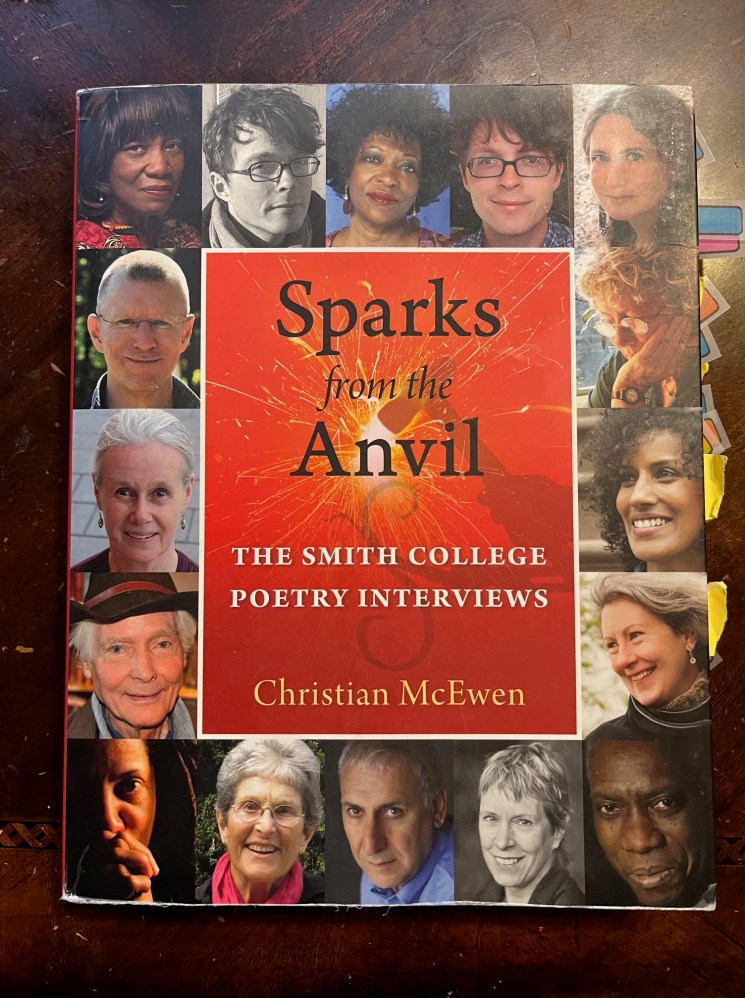
I just read Sparks from the Anvil, a wonderful book of interviews conducted and assembled by Christian McEwen, all from visits to Smith College. The book covers interviews with sixteen different poets, from those earlier in their career to some of those we consider canon (like W.S. Merwin, Rita Dove, Maxine Kumin, Yusef Komunyakaa, and others). I want to pull out a few quotes from the book to give you a flavor of what you can expect.

McEwen asks terrific questions and some of those questions are in search of advice from these poets whether for students or other writers. The poet Matthew Dickman has a great suggestion for those of us who know and love the art form to “…go out and get a book of poems or print up a couple of poems that you really like, and send them to someone who doesn’t read poems. Because they need them, more than you know, and more than they know.” I’m definitely inspired to do just that.

Many of the poets in this book speak to the increasing noise that our culture generates, and their concern that people, poets and otherwise, are able to find space for quiet reflection, the importance of that. Edward Hirsch tells us, “I feel that a certain kind of sustained reading puts us in touch with our interior lives. And that’s endangered in our culture because you need to be alone with yourself, you need some presence, and you need to be able to give yourself up to the experience of absorption.”

In the interview with Jane Hirshfield, Hirshfield discusses much of how her Buddhist practice often informs her writing. I love this passage from her as it applies to how we can create poems that breathe and allow the reader time for discovery. “This is how we change, by letting go of the past, by letting go of the status quo, the reified thought. I think this is why we require sabbath in our lives, and silence in our words: because nothing new can come unless there’s a space for it to enter.”

Lastly, I love how Chase Twichell speaks to the ability of poetry to capture, or at least direct us to, some of the more ethereal of human experiences. “It has been my experience that there are states of mind and kinds of human perception and consciousness that are simply not translatable into language. But language can point at them.”

A Brief Meditation on “We Are Meant to Carry Water”

I recently finished reading the poetry book We Are Meant to Carry Water, a wonderful, collaborative effort by the poets Tina Carlson, Stella Reed and Katherine Diabella Seluja. Such an interesting project, they’ve taken on the task of re-imagining of myths that include both Greek and Hebrew mythology traditions (possibly more, I’m not certain). The book is filled with intriguing and poignant images throughout.

I think my favorite poem in the book had to be “Something Wild.” These closing lines, in particular, transported me with their startling storytelling and imagery, as the young girls in the poem name constellations: “The rest are their invention:/Broken Tooth, Wooden Horse, Piano Bench, as if gossamer light/could anchor them to the spinning top of their world, to the burning/roof of their fate.”

Put out by Three: A Taos Press, this book is definitely worth your time.

Tracy K. Smith’s American Journal

Every book lover knows the feeling when you come across a book that you didn’t know you needed until you saw it and/or read it. American Journal: Fifty Poems for Our Time was one such find for me. The poems in this book, published by Graywolf Press in 2018, were selected by Tracy K. Smith, former U.S. poet laureate. Of writers that have emerged in this fledgling century, Tracy K. Smith is my top pick. And to find a selection of some of her favorite work was pure delight.

I’d like to call out my three favorite poems in this book as a sampling.

First, there is “My Brother at 3 AM” by Natalie Diaz. I have been very interested in the pantoum form lately, and this poem is a superbly haunting execution of it. The line “Stars had closed their eyes or sheaved their knives” was so powerfully poignant in the context of the poem. Diaz uses the repetitive nature of this form to great effect.

On the very next page is Matt Rasmussen’s “Reverse Suicide.” In this poem, Rasmussen experiments with a time reversal mechanic. And he uses that technique very effectively here. I think those last four lines, which create an image of hope and rebirth, give a heartbreaking lens into the processing of grief.

Lastly, I’ll call out Kevin Young’s “Crowning.” This poem is just a brilliant, sensory depiction of birth that is sheer joy to read.

So thank you Tracy K. Smith for providing the world with yet another book to challenge and delight us.