Science-Fiction Books Available in 2025 and 2026 (Hopefully)

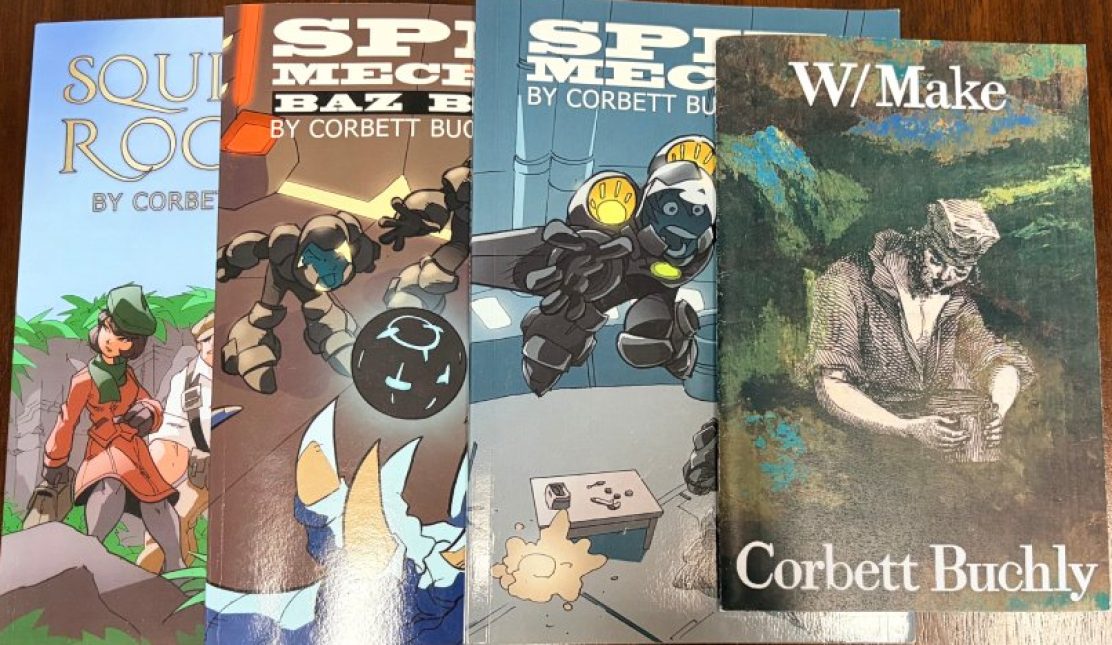
I have decided to attempt to return to my science-fiction work, while maintaining my focus on poetry. For the past five years, I have concentrated almost exclusively on poetry. While I have enjoyed this journey and have no plan to slow down writing and publishing poetry, I have found the strong desire to work and publish in fiction to be almost equally as strong.

So here’s a list of already written books that I am actively re-editing and hope to release in the coming year and a half. A bit ambitious, perhaps, but we have to start somewhere, don’t we? Timing will depend on both how the editing goes and securing the right art work (the two most time-consuming parts of the process). I’m hoping by putting this out there, I’ll feel obligated to persist with such an aggressive schedule.

  1. Steampunk novel set in the American Old West (with a fun science-fiction twist).
  2. Steampunk fantasy novel set in its own world (less steampunk than the previous novel but heavy on the magic).
  3. Book of science-fiction short stories.
  4. Science-fiction chapter book (for grade-school kids).
  5. Chapter book (for grade-school kids). This one is kind of a sports theme but not in the traditional sense.

That’s a lot right? I don’t know about you, but I’m excited! This work represents almost a decade of work.

By getting these books out there into the world, I will then free my fiction-focused time up to focus on my already started (and stopped) projects that include a science-fiction space novel, as well as the third Spit Mechs chapter book.

I have a few poetry book manuscripts that I have been shopping around with publishers (one ever-changing book and two chapbooks). So I’m hoping these will land soon. Fingers crossed, everyone!

If you want to get notified when any of these books launch, the best way is to join my email subscription. (I never spam. To-date, I’ve only sent emails for book launches and events I attend.)

But you can also follow me on my social media handles:

IG: cbuchly

X: WordsAreMessy

FB: CorbettBuchly

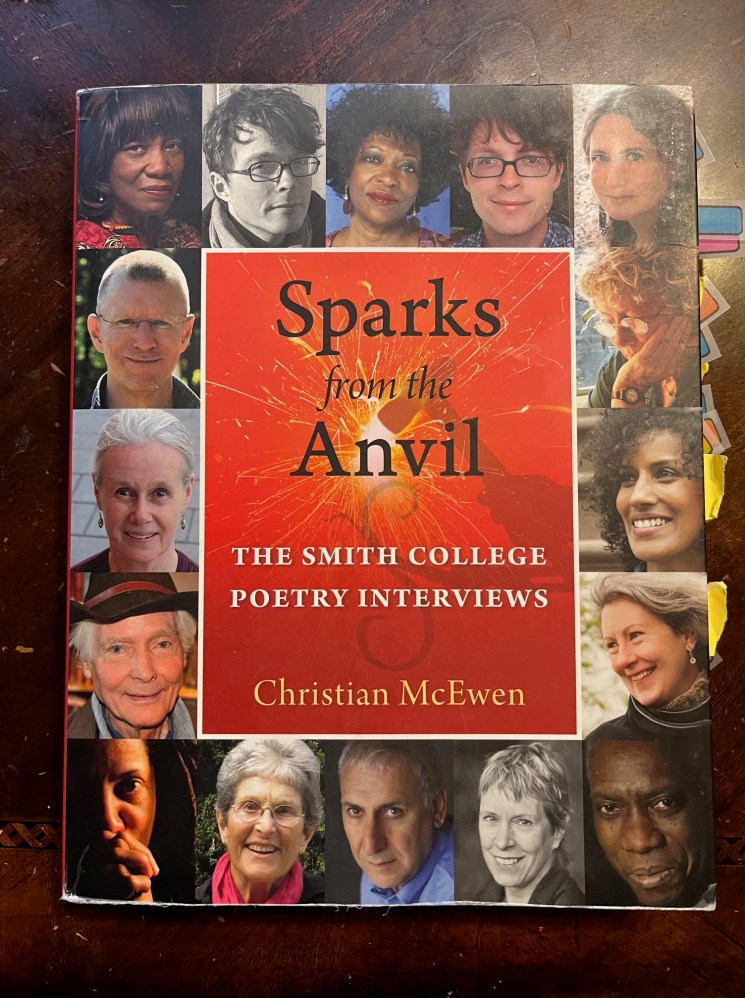
Praise for Sparks from the Anvil

I just read Sparks from the Anvil, a wonderful book of interviews conducted and assembled by Christian McEwen, all from visits to Smith College. The book covers interviews with sixteen different poets, from those earlier in their career to some of those we consider canon (like W.S. Merwin, Rita Dove, Maxine Kumin, Yusef Komunyakaa, and others). I want to pull out a few quotes from the book to give you a flavor of what you can expect.

McEwen asks terrific questions and some of those questions are in search of advice from these poets whether for students or other writers. The poet Matthew Dickman has a great suggestion for those of us who know and love the art form to “…go out and get a book of poems or print up a couple of poems that you really like, and send them to someone who doesn’t read poems. Because they need them, more than you know, and more than they know.” I’m definitely inspired to do just that.

Many of the poets in this book speak to the increasing noise that our culture generates, and their concern that people, poets and otherwise, are able to find space for quiet reflection, the importance of that. Edward Hirsch tells us, “I feel that a certain kind of sustained reading puts us in touch with our interior lives. And that’s endangered in our culture because you need to be alone with yourself, you need some presence, and you need to be able to give yourself up to the experience of absorption.”

In the interview with Jane Hirshfield, Hirshfield discusses much of how her Buddhist practice often informs her writing. I love this passage from her as it applies to how we can create poems that breathe and allow the reader time for discovery. “This is how we change, by letting go of the past, by letting go of the status quo, the reified thought. I think this is why we require sabbath in our lives, and silence in our words: because nothing new can come unless there’s a space for it to enter.”

Lastly, I love how Chase Twichell speaks to the ability of poetry to capture, or at least direct us to, some of the more ethereal of human experiences. “It has been my experience that there are states of mind and kinds of human perception and consciousness that are simply not translatable into language. But language can point at them.”
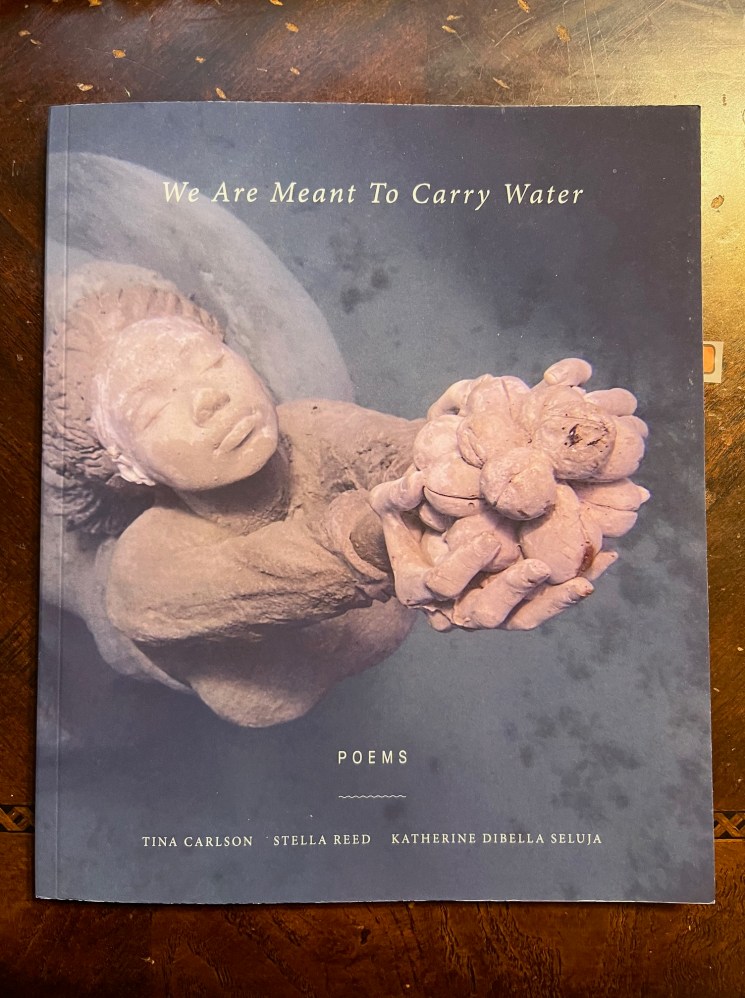
A Brief Meditation on “We Are Meant to Carry Water”

I recently finished reading the poetry book We Are Meant to Carry Water, a wonderful, collaborative effort by the poets Tina Carlson, Stella Reed and Katherine Diabella Seluja. Such an interesting project, they’ve taken on the task of re-imagining of myths that include both Greek and Hebrew mythology traditions (possibly more, I’m not certain). The book is filled with intriguing and poignant images throughout.

I think my favorite poem in the book had to be “Something Wild.” These closing lines, in particular, transported me with their startling storytelling and imagery, as the young girls in the poem name constellations: “The rest are their invention:/Broken Tooth, Wooden Horse, Piano Bench, as if gossamer light/could anchor them to the spinning top of their world, to the burning/roof of their fate.”

Put out by Three: A Taos Press, this book is definitely worth your time.

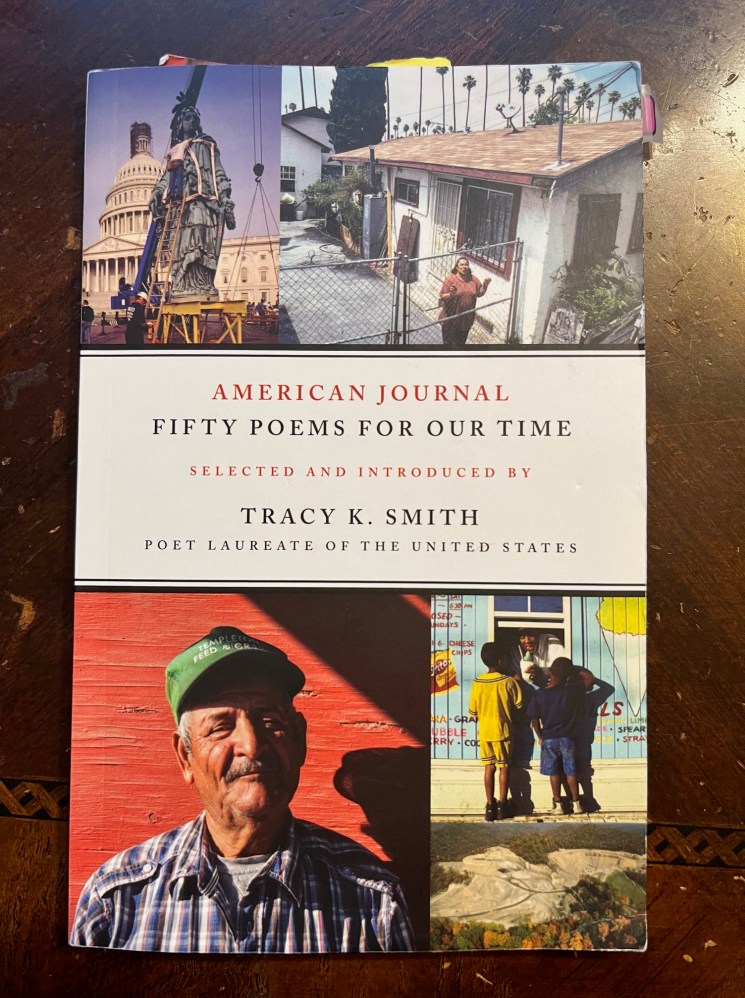
Tracy K. Smith’s American Journal

Every book lover knows the feeling when you come across a book that you didn’t know you needed until you saw it and/or read it. American Journal: Fifty Poems for Our Time was one such find for me. The poems in this book, published by Graywolf Press in 2018, were selected by Tracy K. Smith, former U.S. poet laureate. Of writers that have emerged in this fledgling century, Tracy K. Smith is my top pick. And to find a selection of some of her favorite work was pure delight.

I’d like to call out my three favorite poems in this book as a sampling.

First, there is “My Brother at 3 AM” by Natalie Diaz. I have been very interested in the pantoum form lately, and this poem is a superbly haunting execution of it. The line “Stars had closed their eyes or sheaved their knives” was so powerfully poignant in the context of the poem. Diaz uses the repetitive nature of this form to great effect.

On the very next page is Matt Rasmussen’s “Reverse Suicide.” In this poem, Rasmussen experiments with a time reversal mechanic. And he uses that technique very effectively here. I think those last four lines, which create an image of hope and rebirth, give a heartbreaking lens into the processing of grief.

Lastly, I’ll call out Kevin Young’s “Crowning.” This poem is just a brilliant, sensory depiction of birth that is sheer joy to read.

So thank you Tracy K. Smith for providing the world with yet another book to challenge and delight us.

Listening, Lunching and Meeting With the Poetry Society of Texas

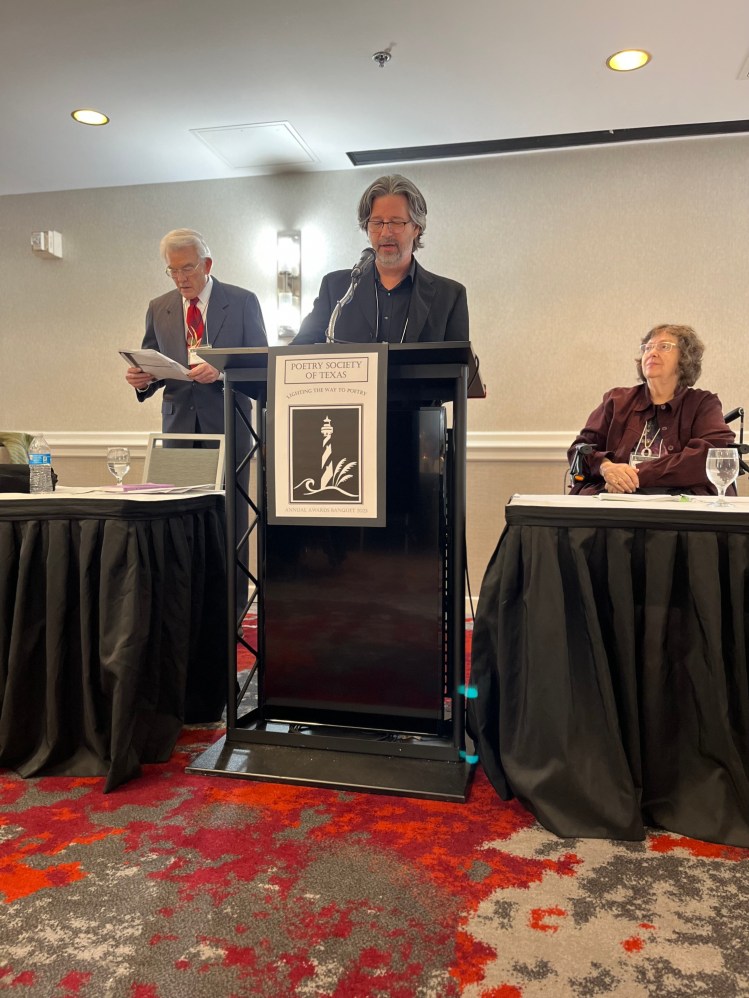
Recently, I got the chance to attend the 2023 Annual Awards Dinner for the Poetry Society of Texas for this first time. It’s always great fun to hang out with fellow poets. I met several writers from the Denton and Mockingbird chapters and got to hear a lot of great poetry.

All of the first place winners in attendance were asked to read their winning poems. I read my poem “what one can see in the dark,” which won The Susan Maxwell Campbell Prize. The name of this prize changes each year and is judged by the previous year’s winner. So next year, I’ll have the opportunity to judge The Corbett Buchly Prize! How fun is that? All of the winning poems will be published in the Poetry Society of Texas Book of the Year.

I thought the best poem of the night was by Diane Glancy, who I now know has had a wonderfully successful career writing and teaching poetry. Of course, I had to buy one of her many books. I’m looking forward with excitement to that arriving. And I look forward to next year’s Poetry Society of Texas event.

On Reading Major Jackson’s A Beat Beyond

After hearing Major Jackson speak at the Scissortail Festival earlier this year, I picked up, among other things, his book of selected prose, A Beat Beyond. For me, the book proved to be an experience sometimes delightful, often poignant, always honest, and frequently inspiring.

In his essay “A Mystifying Silence: Big and Black,” Jackson dives into the some of the differences for poets, especially for those black and white, writing about race, and how shifts in our culture have shaped those efforts. This sentence by Jackson in particular, grabbed me by the collar, “All this to say, in a country whose professed strength is best observed in its plurality of cultures, what seems odd to me (and this I find most appalling about contemporary American poetry) is the dearth of poems written by white poets that address racial issues, that chronicle our struggle as a democracy to find tranquility and harmony as a nation containing many nations.” I have certainly concerned myself with issues of race and inequality in my poems (and written frequently about unity and connection) but it is clearly a delicate subject that I have explored only very carefully. I now feel challenged to explore these ideas more deeply and with greater vulnerability.

I would also like to speak to this salient message from Jackson’s “Introduction to the Best American Poetry 2019:” “For me, the best poems are those in which the author avoids concealment and obfuscation, and the truth of that person, eccentric, vulnerable, and brilliant, bears itself out in a sound heretofore unheard.” Here as in other places in the book, Jackson conveys this idea that a good poem relates to us a unique perspective, that could only be delivered to us from that one author – but also it is an experience that echoes our own humanity through its specificity. An idea that resonates with a similar theme that I strive to get down often with my own work.

A Beat Beyond is a book that speaks very much of Jackson’s own experiences as a black poet, relating to other poets through the lens of American culture, and also his connection to hip-hop. His description of first discovering the Roots on the street is nothing short of hypnotic.

I can’t recommend this book enough.

Recent Public Readings

I recently got a chance to do a few public poetry readings. First, was the annual poetry reading at the Richardson Public Library by the Richardson Poetry Group. Six of us read for about 20 minutes each. It was a great turn out and great to be reading in our own community. Second, was the launch party for the journal Havik, published by Las Positas College. They’ve put out a great 2023 issue, chock full of great work. During the event, they had several authors read their work via Zoom. At one point, they asked where we were from, and they got responses from all over the country, and also Mexico.

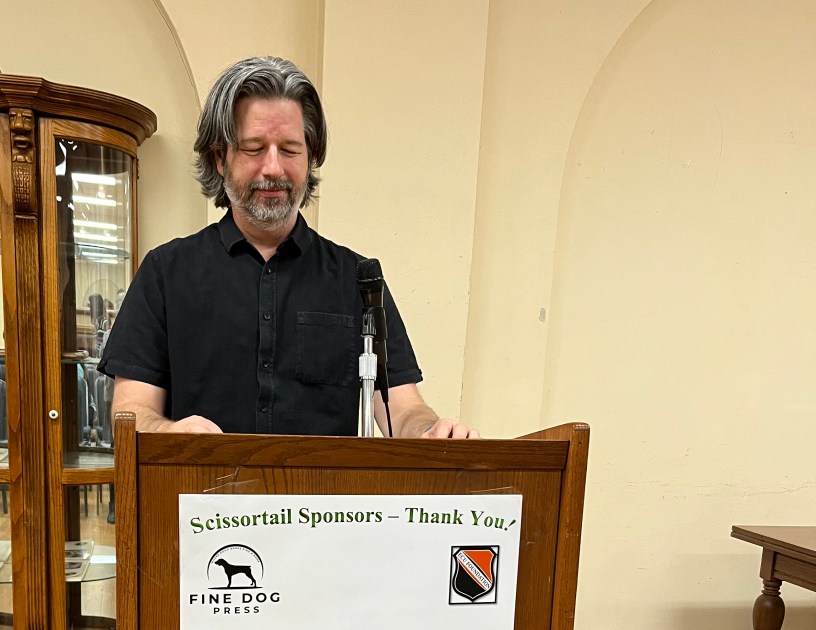
Scissortail Festival 2023

I had the opportunity in early April to attend the Scissortail Festival in Ada, Oklahoma. I drove through some rural country to get to this small town, at one point barreling down an unlit two-lane highway at night. But despite its somewhat remote location, this festival, hosted by East Central University, featured an impressive slate of poets reading their work in 20-minute sprints, with each day’s featured reader being given an hour.

I had the opportunity to discover such unique and talented poets as Tina Carlson, a soulful poet with poems full of stunning and haunting imagery; the expressive Karla K. Morton and her arresting poem that paralleled the death of a friend with the consumption of a frail quail dinner; Paul Juhasz, with his careful blend of pop culture and moments of surprising gravity; and David Meischen, and his compelling tales of growing up as a gay youth in a small town environment. I already knew Alan Gann and Ann Howells from the Dallas poetry scene, and of course, they both gave wonderful readings. But there were so many more wonderful poets that I haven’t listed.

The first night’s featured reader was Major Jackson, and he did not disappoint. Among many others, he read one particularly fascinating poem in which his two halves/selves interacted with each other. I thoroughly enjoyed his reading and have already had the chance to tune into several episodes of his podcast, The Slow Down. It’s quite good, featuring a single poem a day by other poets.

I also got my chance at my 20 minutes to read my own poems. I hadn’t had the opportunity to read in public since before the pandemic, and it was wonderful getting those real-time reactions from my work (especially from such a warm crowd). So many people I spoke with were surprised that I didn’t have a book for sale. Believe me, I am working on circulating that manuscript. Perhaps my favorite aspect of this experience, though it’s hard to choose, was getting to meet and chat with so many poets. There is something to be said for getting into conversation with others who share your passion, an opportunity I don’t seem to get as often as I’d like. I sincerely hope that this may seed a few friendships.

Kunitz and the Recurrence of Personal Images and Themes in Poetry

When asked if a poet can talk about his own key images that go back to his roots, Stanley Kunitz said, “Not unless he’s very sick, or very foolish …. One oughtn’t try to explain everything away, even if one could. It’s enough to reconcile oneself to the existence of an image from which one never gets very far.”

While I don’t seek out these reoccurring images and themes, like most poets, I think, I find them returning again and again. I do think it’s important to seek out new ways to explore them. We should avoid stagnancy in our thinking, but not the deepening or enriching of a theme, or even its evolution.

Some of the themes I’ve found myself returning to time and again include: feelings of loss from my father’s death, feelings of anxiety that I think stem predominantly from a felt need to protect those around me from the unseen dangers of the world, and this idea of transcendental connection between all of humanity, and even all life. Even today though, I feel myself moving into new themes that I’ve yet to quite pin down.

W.P. Snodgrass on What a Poem Needs

In an interview with New York Quarterly years ago, W. P. Snodgrass said, “I think that for a poem you’ve got to have one of three things: either a new idea, which is awfully unlikely, or a new set of details or a new style.” I like what he’s trying to say about the goals of good poetry. A poem can do many things, but offering a new perspective is certainly one of the most critical. In fact, I think I would add “offer a new way of looking at something” to that list, although it overlaps quite a bit with what he’s already said.