Listening, Lunching and Meeting With the Poetry Society of Texas

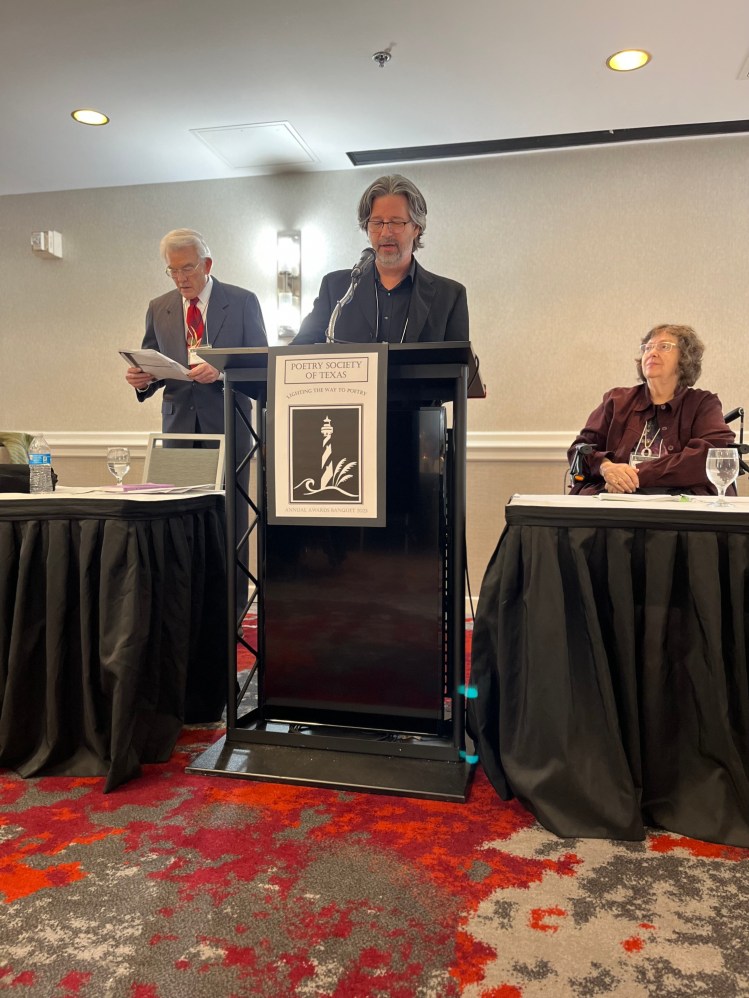
Recently, I got the chance to attend the 2023 Annual Awards Dinner for the Poetry Society of Texas for this first time. It’s always great fun to hang out with fellow poets. I met several writers from the Denton and Mockingbird chapters and got to hear a lot of great poetry.

All of the first place winners in attendance were asked to read their winning poems. I read my poem “what one can see in the dark,” which won The Susan Maxwell Campbell Prize. The name of this prize changes each year and is judged by the previous year’s winner. So next year, I’ll have the opportunity to judge The Corbett Buchly Prize! How fun is that? All of the winning poems will be published in the Poetry Society of Texas Book of the Year.

I thought the best poem of the night was by Diane Glancy, who I now know has had a wonderfully successful career writing and teaching poetry. Of course, I had to buy one of her many books. I’m looking forward with excitement to that arriving. And I look forward to next year’s Poetry Society of Texas event.

On Reading Major Jackson’s A Beat Beyond

After hearing Major Jackson speak at the Scissortail Festival earlier this year, I picked up, among other things, his book of selected prose, A Beat Beyond. For me, the book proved to be an experience sometimes delightful, often poignant, always honest, and frequently inspiring.

In his essay “A Mystifying Silence: Big and Black,” Jackson dives into the some of the differences for poets, especially for those black and white, writing about race, and how shifts in our culture have shaped those efforts. This sentence by Jackson in particular, grabbed me by the collar, “All this to say, in a country whose professed strength is best observed in its plurality of cultures, what seems odd to me (and this I find most appalling about contemporary American poetry) is the dearth of poems written by white poets that address racial issues, that chronicle our struggle as a democracy to find tranquility and harmony as a nation containing many nations.” I have certainly concerned myself with issues of race and inequality in my poems (and written frequently about unity and connection) but it is clearly a delicate subject that I have explored only very carefully. I now feel challenged to explore these ideas more deeply and with greater vulnerability.

I would also like to speak to this salient message from Jackson’s “Introduction to the Best American Poetry 2019:” “For me, the best poems are those in which the author avoids concealment and obfuscation, and the truth of that person, eccentric, vulnerable, and brilliant, bears itself out in a sound heretofore unheard.” Here as in other places in the book, Jackson conveys this idea that a good poem relates to us a unique perspective, that could only be delivered to us from that one author – but also it is an experience that echoes our own humanity through its specificity. An idea that resonates with a similar theme that I strive to get down often with my own work.

A Beat Beyond is a book that speaks very much of Jackson’s own experiences as a black poet, relating to other poets through the lens of American culture, and also his connection to hip-hop. His description of first discovering the Roots on the street is nothing short of hypnotic.

I can’t recommend this book enough.

Recent Public Readings

I recently got a chance to do a few public poetry readings. First, was the annual poetry reading at the Richardson Public Library by the Richardson Poetry Group. Six of us read for about 20 minutes each. It was a great turn out and great to be reading in our own community. Second, was the launch party for the journal Havik, published by Las Positas College. They’ve put out a great 2023 issue, chock full of great work. During the event, they had several authors read their work via Zoom. At one point, they asked where we were from, and they got responses from all over the country, and also Mexico.

Scissortail Festival 2023

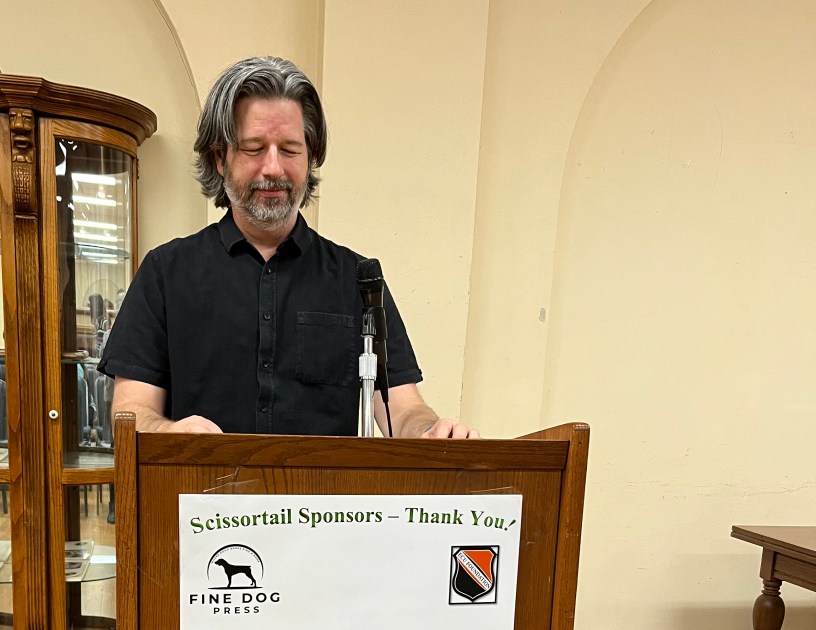
I had the opportunity in early April to attend the Scissortail Festival in Ada, Oklahoma. I drove through some rural country to get to this small town, at one point barreling down an unlit two-lane highway at night. But despite its somewhat remote location, this festival, hosted by East Central University, featured an impressive slate of poets reading their work in 20-minute sprints, with each day’s featured reader being given an hour.

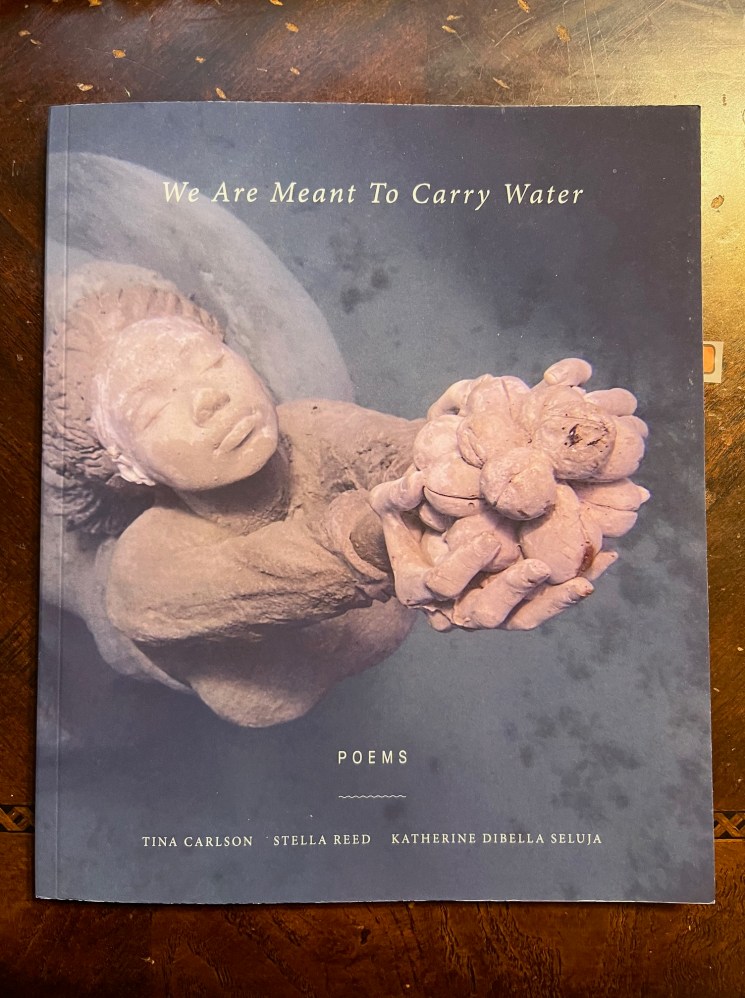
I had the opportunity to discover such unique and talented poets as Tina Carlson, a soulful poet with poems full of stunning and haunting imagery; the expressive Karla K. Morton and her arresting poem that paralleled the death of a friend with the consumption of a frail quail dinner; Paul Juhasz, with his careful blend of pop culture and moments of surprising gravity; and David Meischen, and his compelling tales of growing up as a gay youth in a small town environment. I already knew Alan Gann and Ann Howells from the Dallas poetry scene, and of course, they both gave wonderful readings. But there were so many more wonderful poets that I haven’t listed.

The first night’s featured reader was Major Jackson, and he did not disappoint. Among many others, he read one particularly fascinating poem in which his two halves/selves interacted with each other. I thoroughly enjoyed his reading and have already had the chance to tune into several episodes of his podcast, The Slow Down. It’s quite good, featuring a single poem a day by other poets.

I also got my chance at my 20 minutes to read my own poems. I hadn’t had the opportunity to read in public since before the pandemic, and it was wonderful getting those real-time reactions from my work (especially from such a warm crowd). So many people I spoke with were surprised that I didn’t have a book for sale. Believe me, I am working on circulating that manuscript. Perhaps my favorite aspect of this experience, though it’s hard to choose, was getting to meet and chat with so many poets. There is something to be said for getting into conversation with others who share your passion, an opportunity I don’t seem to get as often as I’d like. I sincerely hope that this may seed a few friendships.

Kunitz and the Recurrence of Personal Images and Themes in Poetry

When asked if a poet can talk about his own key images that go back to his roots, Stanley Kunitz said, “Not unless he’s very sick, or very foolish …. One oughtn’t try to explain everything away, even if one could. It’s enough to reconcile oneself to the existence of an image from which one never gets very far.”

While I don’t seek out these reoccurring images and themes, like most poets, I think, I find them returning again and again. I do think it’s important to seek out new ways to explore them. We should avoid stagnancy in our thinking, but not the deepening or enriching of a theme, or even its evolution.

Some of the themes I’ve found myself returning to time and again include: feelings of loss from my father’s death, feelings of anxiety that I think stem predominantly from a felt need to protect those around me from the unseen dangers of the world, and this idea of transcendental connection between all of humanity, and even all life. Even today though, I feel myself moving into new themes that I’ve yet to quite pin down.

W.P. Snodgrass on What a Poem Needs

In an interview with New York Quarterly years ago, W. P. Snodgrass said, “I think that for a poem you’ve got to have one of three things: either a new idea, which is awfully unlikely, or a new set of details or a new style.” I like what he’s trying to say about the goals of good poetry. A poem can do many things, but offering a new perspective is certainly one of the most critical. In fact, I think I would add “offer a new way of looking at something” to that list, although it overlaps quite a bit with what he’s already said.

Eschewing Punctuation and Capitalization in Poetry

A poet friend recently asked me why I do not use capital letters or punctuation in my poetry. While I have different reasons for both choices, there are two overarching philosophies that answer to both. Balance and ambiguity.

First, I’ll address the idea of balance, and by balance, I mean giving every word, every line an equal opportunity to affect the experience and meaning of the poem. When we emphasize certain words by capitalization we overshadow the agency of other words. And when we cut up our lines with punctuation, we cut off avenues of meaning.

That brings me to the idea of ambiguity in poetry. While I write with purpose, I also believe it is critical for the poet to open themselves up to the subconscious, to be wholly open to receiving new direction, images and ideas. One of the things poetry does better than any other art form is to connect ideas usually not connected. We open ourselves up to possibility. By letting a poem breathe and flow with little to no punctuation, and without capitalization, we increase the chances that those connections will occur.

I assure you, I still believe in pauses. Just as we pause in our natural speech, which is often controlled by the breath, or “breath-stops” as Alan Ginsberg called them, the rhythm that poetry craves demands we pause. For me, this is most often the end of a line. Every so often, I will add a simple punctuation mark in the middle of a line if I feel that meaning will dissolve without it. But generally, I try to avoid this. I also find that we can have pauses in the middle of a line simply because of the natural flow of speech, without need for a signifying punctuation mark.

A common poetic practice, a traditional one, is to capitalize the first letter of a line. I see no absolutely no reason for this, and in fact, find it quite distracting. Why would that word have more emphasis than another? And it most certainly fights against enjambment. Should those two words be together? The capital in between them argues, “Certainly not!”

Writing poetry is not like writing prose, of course. And part of that difference, I think, is trying to find ways to weave multiple meanings through the work that could not exist as easily with the blockages that capital letters and punctuation set up.

A poem is a breathing creature which can create meaning from the subconscious of both its author and its reader. A poem reaches its fullest potential in that moment when the experiences and perspectives of its author meet those of the reader. It’s best to not get in the way of the poem’s need to connect itself in surprising ways.

A Quick Guide to Useful Books for the Active Poet

Having read several books recently on the writing of poetry, I thought it would be good to provide a quick guide on some of those I found the most useful.

A Poetry Handbook (by Mary Oliver) – This is a great overview of poetry writing. I rarely reread books, but I’ve reread portions of this one.

The Ode Less Travelled (by Stephen Fry) – The best book I’ve read on forms. It’s so well-written. Fry, of course, is a professional actor, but as he refers to himself, an amateur poet. Doesn’t matter. His writing is spot-on and highly practical.

Nine Gates (by Jane Hirshfield)  – How to describe this book? These nine essays cover a lot of ground in the poetry craft, but what Hirshfield does best is to deal with some of the more mystical questions in poetry.

The Sounds of Poetry (by Robert Pinsky) – What it sounds like. Really helps you understand how sound goes to work in a poem. Mary Oliver’s book touches on this too.

The Art of Syntax (by Elllen Bryant Voigt) – This deals specifically with the tension between a poem’s syntax and its form. An illuminating perspective that I don’t think all poets consider in their writing.

The Practicing Poet (by Diane Lockward) – To describe this book as a series of prompts with examples and discussion doesn’t seem to do it justice. I worked through the entire book over the course of a year and found it very fruitful for my own writing. My published poem “Coiled Drum Bides in Stillness” (Interpreter’s House, 2020) emerged from one of these prompts.

At Home in the Dark (by David Elliott) – Elliott interviews 10 prominent poets. A terrific read on the topics dear to poets. I want to find more books like this.

52 Ways of Look at a Poem (by Ruth Padel) – The introduction to this book is a top-notch and insightful summation of modern poetry. The book then takes you through 52 poems and dissects them. This is a really good book for understanding how successful poems work.

Enjoy!

How Quiet Drives Good Poetry

Last night, after I thought everyone had gone to bed, I was working on editing a poem’s title, which I knew was simply not right. It was too simplistic, explicit and redundant with the poem’s text. I had jotted down a few ideas and was in the middle of this process when my son walked in and started talking about a tennis racket he was researching. And you guessed it, whatever breakthrough I was about to make on that title was gone.

Writing poetry begs for a deep quiet. This is a quiet that pertains to the mind more than the sounds around us, although silences help. Poetry is deep observation and contemplation and rumination, and letting disparate ideas blunder about the quiet spaces to see how they interact.

William Stafford in an interview with David Elliott in his book of conversations, At Home in the Dark, said, “…for me the experience of finding the way in writing is one of sensitivity, listening, glimpsing, going forward by means of little signals, and those little signals are available in conditions of quiet, lack of turbulence, and conditions that are non-confrontational….I think that one finds one’s way of with a sensibility that requires an attitude other than loudness or aggression.”

Stafford’s extension of this idea to being the antithesis of loudness and aggression certainly resonated with me. Poetry, in the way Stafford means and in the way I most appreciate it, is the opposite of this brash, angry grandstanding of cultish politics.

There is a certain level of sorcery to poetry writing that goes beyond thoughtfulness. There is this idea of being quietly open and receptive to what the world and the words want to say.

Robert Pinsky "The Sounds of Poetry"

A Poetic Exercise in Accentual Verse

I was reading Robert Pinsky’s terrific book The Sounds of Poetry, and I came cross James Wright’s wonderful poem “The First Days.” While Pinksy was concerned in this passage with other matters (predominantly how free verse flirts with iambic pentameter), I became interested in using the poem as an example of accentual verse.

First, I will present an excerpt of this poem to you without comment.

The first thing I saw in the morning

Was a huge golden bee ploughing

His burly right shoulder into the belly

Of a sleek yellow pear

Low on a bough.

Before he could find that sudden black honey

That squirms around in there

Inside the seed, the tree could not bear any more.

The pear fell to the ground,

With the bee still half alive

inside its body.

If we are listening closely, I think one of the things we notice right away are the few dense clusters of closely knit accents, such as “huge golden bee ploughing,” “burly right shoulder” or “sleek yellow pear.” These clusters really serve to slow down the pace of the poem, while providing some aural punch.

In the following version, I’ve bolded each syllable I feel is accented in regular speech. Note, I haven’t accented every syllable you would in the sing-song patter of iambic verse. I believe this is the way in which the natural voice would really scan these lines. I’ve also written the number of accents I’ve noted at the beginning of each line.

3 The first thing I saw in the morning

4 Was a huge golden bee ploughing

5 His burly right shoulder into the belly

3 Of a sleek yellow pear

2 Low on a bough.

5 Before he could find that sudden black honey

3 That squirms around in there

5 Inside the seed, the tree could not bear any more.

3 The pear fell to the ground,

4 With the bee still half alive

2 inside its body.

You can see that the lines pulse between the long and short number of accents. And hopefully, you can also detect how the poem speeds up and slows down as the accents are more or less densely packed. “Was a huge golden bee ploughing” has a very different pace and feel than “Before he could find that sudden black honey.” The accent I’ve put on “to” in the third line is arguable, but that’s how I hear it. You’ll also notice how I have not accented certain words that might be normally accented in an accentual-syllabic reading, such as “first” in the first line or “could” in the sixth line. But to me, that’s the power of free verse; natural language and the context of the words most inform their stress.