John Corbett's character Chris Stevens reading literature on Northern Exposure

The Literary Allusions in Northern Exposure

Recently, I have been rewatching Northern Exposure. Yes, this TV series is over 30 years old, but the series has a particular nostalgia for me. Often while watching the show with my mother, one of the characters, often John Corbett’s Chris Stevens, would make a literary reference. And I would point to my corner bookshelves and say, “Yeah, I’ve got that book over there.” It’s like they had my home library for reference. It has been a little uncanny. Which of course, endeared me to the series even more. I by no means have a comprehensive library, but whoever was writing for the show had gravitated toward many of the same classics I had. I detect the machinations of a cultural zeitgeist at work.

The one reference that inspired me to write this blog was to a work I had not read, “Remembrance of Things Past” by Marcel Proust. It was such a beautiful passage though, I felt compelled to pick up the novel (the first in a series). Corbett’s DJ character read this one on the air:

When from a long distant past nothing persists, after the people are dead, after things are broken and scattered, still alone, more persistent, more faithful, the smell and taste of things remain poised a long, long time like souls, ready to remind us, waiting, hoping for their moment amid the ruins of all the rest, and bear unfaltering in the tiny and almost impalpable drop of their essence the vast structure of recollection.

Certainly, speech patterns change over time, but I found this prose so lyrical as to be magical. I found myself wondering if writing like this gets weeded out these days as too alienating to readers, or if it simply isn’t written.

The Chris Stevens character has a meandering, philosophical and well-educated style of pontification, which he delivers mostly over the radio, but also to fellow members of the town as a kind of defacto psychiatrist. I delight in the intellectual inquisitive nature of the dialogue that I haven’t found anywhere else.

Here’s a short list of literary references I know of made on the show that occupy space on my library shelves:

Zen and the Art of Motorcycle Maintenance, Robert M. Pirsig

In Dreams Begin Responsibility, Delmore Schwartz

Plays of William Shakespeare (The Tempest)

Leaves of Grass/Song of Myself, Walt Whitman

On Walden, Henry David Thoreau

The Stranger, Albert Camus

The Call of the Wild, Jack London

The Power of Myth + The Hero With a Thousand Faces, Joseph Campbell

The Raven, Edgar Allan Poe

Other authors mentioned include: Fyodor Dostoevsky, Franz Kafka, Carl G. Jung, William Wordsworth, Edna St. Vincent Millay, Friedrich Nietzsche, Herman Melville and Emily Dickinson.

What fun!

Science-Fiction Books Available in 2025 and 2026 (Hopefully)

I have decided to attempt to return to my science-fiction work, while maintaining my focus on poetry. For the past five years, I have concentrated almost exclusively on poetry. While I have enjoyed this journey and have no plan to slow down writing and publishing poetry, I have found the strong desire to work and publish in fiction to be almost equally as strong.

So here’s a list of already written books that I am actively re-editing and hope to release in the coming year and a half. A bit ambitious, perhaps, but we have to start somewhere, don’t we? Timing will depend on both how the editing goes and securing the right art work (the two most time-consuming parts of the process). I’m hoping by putting this out there, I’ll feel obligated to persist with such an aggressive schedule.

  1. Steampunk novel set in the American Old West (with a fun science-fiction twist).
  2. Steampunk fantasy novel set in its own world (less steampunk than the previous novel but heavy on the magic).
  3. Book of science-fiction short stories.
  4. Science-fiction chapter book (for grade-school kids).
  5. Chapter book (for grade-school kids). This one is kind of a sports theme but not in the traditional sense.

That’s a lot right? I don’t know about you, but I’m excited! This work represents almost a decade of work.

By getting these books out there into the world, I will then free my fiction-focused time up to focus on my already started (and stopped) projects that include a science-fiction space novel, as well as the third Spit Mechs chapter book.

I have a few poetry book manuscripts that I have been shopping around with publishers (one ever-changing book and two chapbooks). So I’m hoping these will land soon. Fingers crossed, everyone!

If you want to get notified when any of these books launch, the best way is to join my email subscription. (I never spam. To-date, I’ve only sent emails for book launches and events I attend.)

But you can also follow me on my social media handles:

IG: cbuchly

X: WordsAreMessy

FB: CorbettBuchly

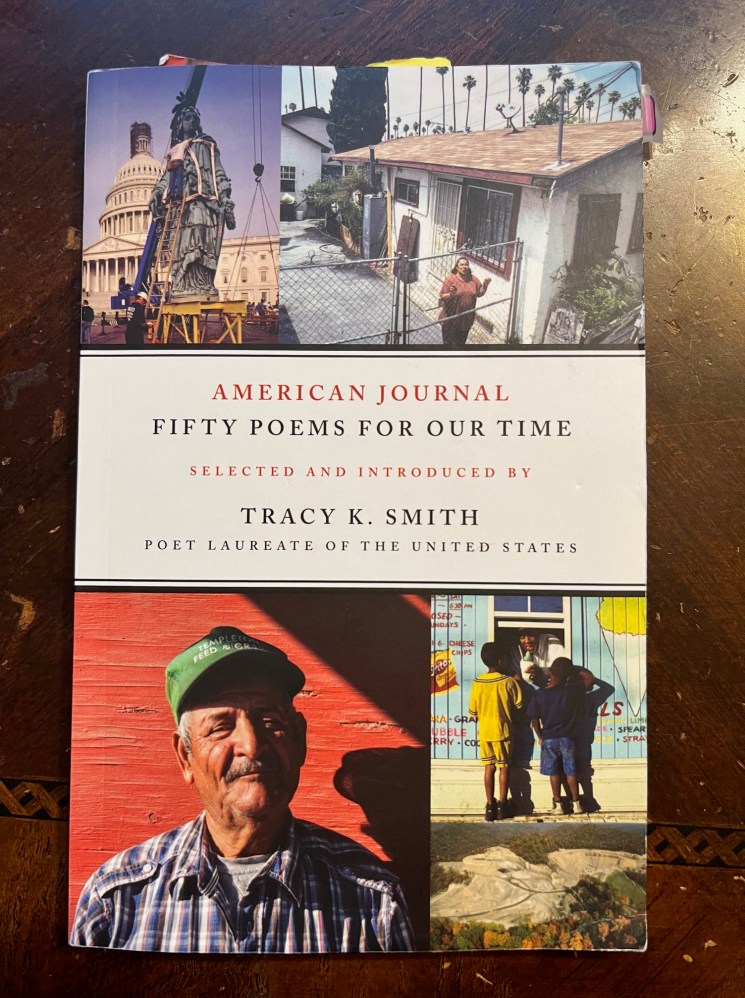
Tracy K. Smith’s American Journal

Every book lover knows the feeling when you come across a book that you didn’t know you needed until you saw it and/or read it. American Journal: Fifty Poems for Our Time was one such find for me. The poems in this book, published by Graywolf Press in 2018, were selected by Tracy K. Smith, former U.S. poet laureate. Of writers that have emerged in this fledgling century, Tracy K. Smith is my top pick. And to find a selection of some of her favorite work was pure delight.

I’d like to call out my three favorite poems in this book as a sampling.

First, there is “My Brother at 3 AM” by Natalie Diaz. I have been very interested in the pantoum form lately, and this poem is a superbly haunting execution of it. The line “Stars had closed their eyes or sheaved their knives” was so powerfully poignant in the context of the poem. Diaz uses the repetitive nature of this form to great effect.

On the very next page is Matt Rasmussen’s “Reverse Suicide.” In this poem, Rasmussen experiments with a time reversal mechanic. And he uses that technique very effectively here. I think those last four lines, which create an image of hope and rebirth, give a heartbreaking lens into the processing of grief.

Lastly, I’ll call out Kevin Young’s “Crowning.” This poem is just a brilliant, sensory depiction of birth that is sheer joy to read.

So thank you Tracy K. Smith for providing the world with yet another book to challenge and delight us.

A Quick Guide to Useful Books for the Active Poet

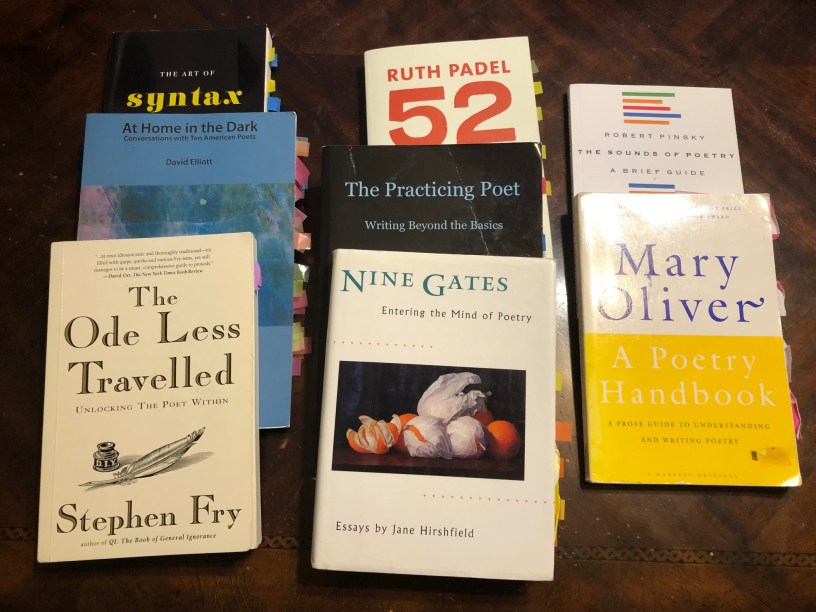
Having read several books recently on the writing of poetry, I thought it would be good to provide a quick guide on some of those I found the most useful.

A Poetry Handbook (by Mary Oliver) – This is a great overview of poetry writing. I rarely reread books, but I’ve reread portions of this one.

The Ode Less Travelled (by Stephen Fry) – The best book I’ve read on forms. It’s so well-written. Fry, of course, is a professional actor, but as he refers to himself, an amateur poet. Doesn’t matter. His writing is spot-on and highly practical.

Nine Gates (by Jane Hirshfield)  – How to describe this book? These nine essays cover a lot of ground in the poetry craft, but what Hirshfield does best is to deal with some of the more mystical questions in poetry.

The Sounds of Poetry (by Robert Pinsky) – What it sounds like. Really helps you understand how sound goes to work in a poem. Mary Oliver’s book touches on this too.

The Art of Syntax (by Elllen Bryant Voigt) – This deals specifically with the tension between a poem’s syntax and its form. An illuminating perspective that I don’t think all poets consider in their writing.

The Practicing Poet (by Diane Lockward) – To describe this book as a series of prompts with examples and discussion doesn’t seem to do it justice. I worked through the entire book over the course of a year and found it very fruitful for my own writing. My published poem “Coiled Drum Bides in Stillness” (Interpreter’s House, 2020) emerged from one of these prompts.

At Home in the Dark (by David Elliott) – Elliott interviews 10 prominent poets. A terrific read on the topics dear to poets. I want to find more books like this.

52 Ways of Look at a Poem (by Ruth Padel) – The introduction to this book is a top-notch and insightful summation of modern poetry. The book then takes you through 52 poems and dissects them. This is a really good book for understanding how successful poems work.

Enjoy!

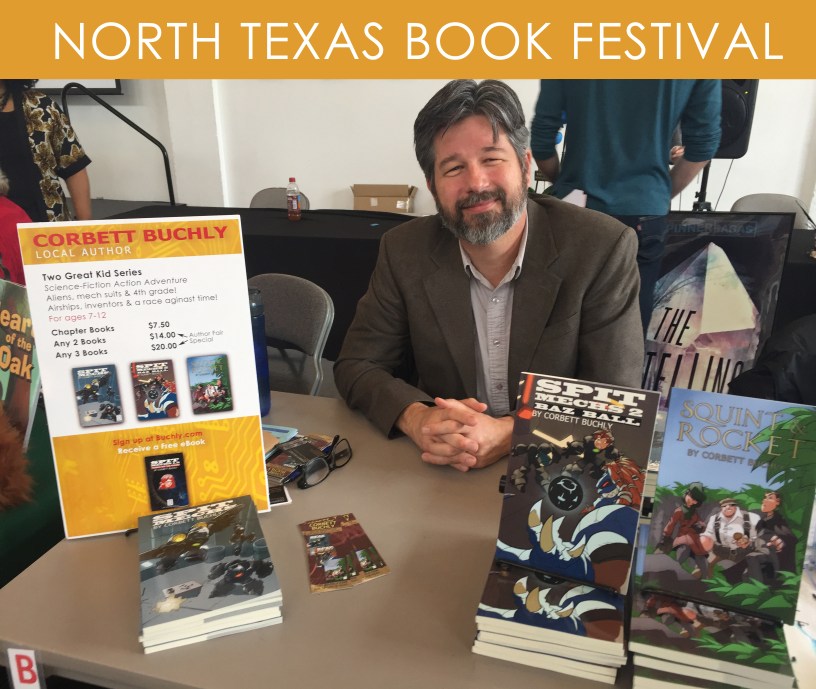
Talking Books at North Texas Book Festival

This past weekend, I attended the North Texas Book Festival and had the pleasure of interacting with new readers and fellow authors. These are always some of the best conversations.

The North Texas Book Festival is held annually in Denton, Texas. Home to the University of North Texas, Denton supports a vibrant cultural life of arts, music and literature. The morning of the festival, a big thunderstorm rolled through. Authors like myself dashed from our cars with our carts of books, signs and giveaways, hoping to get  it all safe and dry to the venue. The rain kept many away in the morning. But as the sky cleared, festival traffic picked up, and I had the chance to meet with some of the local book nerds.

All in all, it was a great experience, and I hope to be back in Denton next year.

Author Fair at Richardson Public Library

This past Saturday, I had the chance to meet with local readers, fans and other authors at the Author Fair put on by the Richardson Public Library. Library fairs are the best because attendees are interested in one thing — books. As you might guess, I could talk all day on that very subject.

In addition to meeting with several terrific area fans and readers, I spoke with some fascinating authors, such as TJ Xia (can’t wait to read his super well-researched book on creativity and innovation), T.D. Walker (looking forward to her book of science-fiction poetry next year) and Diane Cobalt (writer of successful suspense trilogy Fatal Impact). I also picked up several new ideas for marketing and author networking.

If you’re in the area and you missed the Richardson Library’s first author fair this year, look for it next year. I plan to be there with a new book or two to share with you.