Praise for Sparks from the Anvil

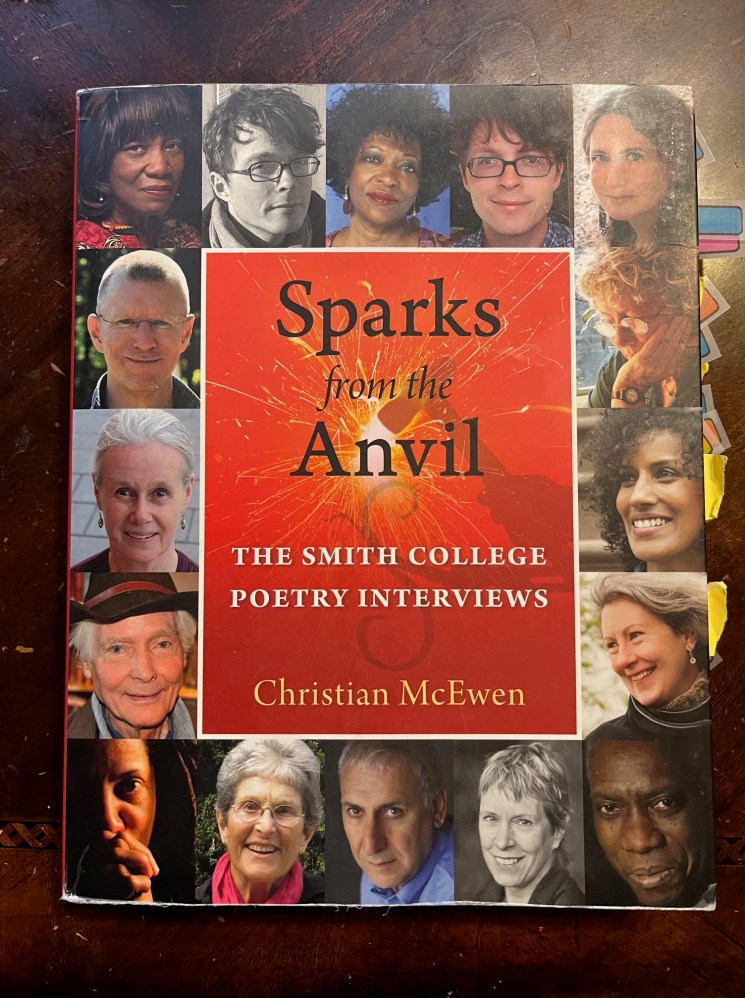
I just read Sparks from the Anvil, a wonderful book of interviews conducted and assembled by Christian McEwen, all from visits to Smith College. The book covers interviews with sixteen different poets, from those earlier in their career to some of those we consider canon (like W.S. Merwin, Rita Dove, Maxine Kumin, Yusef Komunyakaa, and others). I want to pull out a few quotes from the book to give you a flavor of what you can expect.

McEwen asks terrific questions and some of those questions are in search of advice from these poets whether for students or other writers. The poet Matthew Dickman has a great suggestion for those of us who know and love the art form to “…go out and get a book of poems or print up a couple of poems that you really like, and send them to someone who doesn’t read poems. Because they need them, more than you know, and more than they know.” I’m definitely inspired to do just that.

Many of the poets in this book speak to the increasing noise that our culture generates, and their concern that people, poets and otherwise, are able to find space for quiet reflection, the importance of that. Edward Hirsch tells us, “I feel that a certain kind of sustained reading puts us in touch with our interior lives. And that’s endangered in our culture because you need to be alone with yourself, you need some presence, and you need to be able to give yourself up to the experience of absorption.”

In the interview with Jane Hirshfield, Hirshfield discusses much of how her Buddhist practice often informs her writing. I love this passage from her as it applies to how we can create poems that breathe and allow the reader time for discovery. “This is how we change, by letting go of the past, by letting go of the status quo, the reified thought. I think this is why we require sabbath in our lives, and silence in our words: because nothing new can come unless there’s a space for it to enter.”

Lastly, I love how Chase Twichell speaks to the ability of poetry to capture, or at least direct us to, some of the more ethereal of human experiences. “It has been my experience that there are states of mind and kinds of human perception and consciousness that are simply not translatable into language. But language can point at them.”

A Quick Guide to Useful Books for the Active Poet

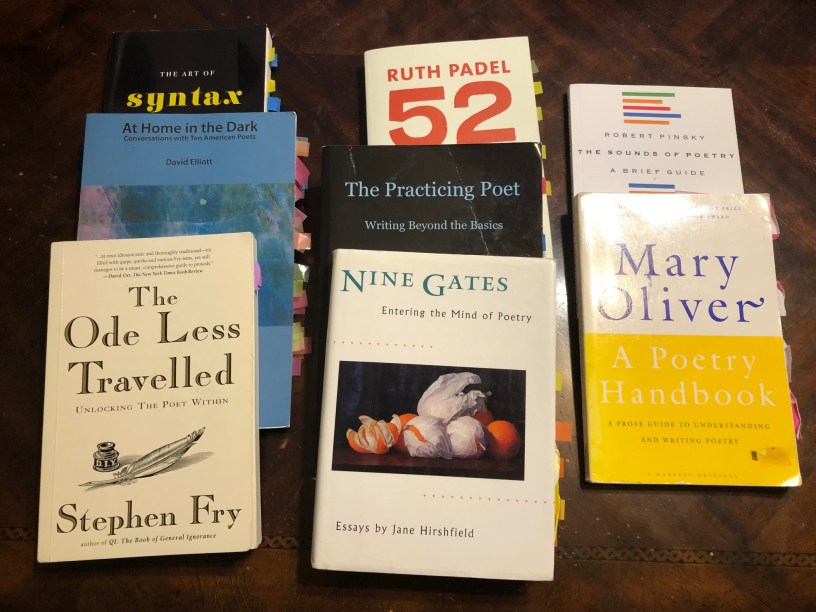
Having read several books recently on the writing of poetry, I thought it would be good to provide a quick guide on some of those I found the most useful.

A Poetry Handbook (by Mary Oliver) – This is a great overview of poetry writing. I rarely reread books, but I’ve reread portions of this one.

The Ode Less Travelled (by Stephen Fry) – The best book I’ve read on forms. It’s so well-written. Fry, of course, is a professional actor, but as he refers to himself, an amateur poet. Doesn’t matter. His writing is spot-on and highly practical.

Nine Gates (by Jane Hirshfield)  – How to describe this book? These nine essays cover a lot of ground in the poetry craft, but what Hirshfield does best is to deal with some of the more mystical questions in poetry.

The Sounds of Poetry (by Robert Pinsky) – What it sounds like. Really helps you understand how sound goes to work in a poem. Mary Oliver’s book touches on this too.

The Art of Syntax (by Elllen Bryant Voigt) – This deals specifically with the tension between a poem’s syntax and its form. An illuminating perspective that I don’t think all poets consider in their writing.

The Practicing Poet (by Diane Lockward) – To describe this book as a series of prompts with examples and discussion doesn’t seem to do it justice. I worked through the entire book over the course of a year and found it very fruitful for my own writing. My published poem “Coiled Drum Bides in Stillness” (Interpreter’s House, 2020) emerged from one of these prompts.

At Home in the Dark (by David Elliott) – Elliott interviews 10 prominent poets. A terrific read on the topics dear to poets. I want to find more books like this.

52 Ways of Look at a Poem (by Ruth Padel) – The introduction to this book is a top-notch and insightful summation of modern poetry. The book then takes you through 52 poems and dissects them. This is a really good book for understanding how successful poems work.

Enjoy!