The poet's notebook opened to the blank page.

7 Essential Tips for Young Poets on Finding the Poem


You love poetry. That’s where we all begin – love of a good poem. Now, it’s time to write your own poems. But you hate what you’ve written. Now what?

1. Free Writing

After you’ve picked an interesting starting point for your poem, which can be as simple as the tree in your front yard, start writing. Write the good, write the bad, write what comes into your head. Soon, with practice, you’ll follow the path from something mundane to something interesting. Keep writing. Even after you think you’re done, keep writing. Magic can happen here and often does. It’s a bit of stream of consciousness, it’s a bit of free association, and it’s a bit of triggering the subsconscious. When you do finish, you’re not finished. See tip number seven.

2. Research

Find a topic that interests you and dive into the research. Whales? The violent crime rate? Farming techniques in the middle ages? Take notes. Learn your topic, so that when you do begin writing your poem, you have a feel for what it is you’re exploring. Although I often take copious notes during my research phase, I rarely use all of my research. It’s a jumping off point. It helps me understand the world that I’m writing about. And when I’m writing, I lean in to what I sense is important or interesting or needed in the poem. But doing your research can so often lend a texture to your poetry that you cannot get without it. It’s not essential, but it can make for rich details and bring your audience into a world that they had not yet explored.

3. Observe

So much good poetry centers around intense observation. Whatever it is you’re writing about, strive to really see it, and see it from all angles. Strip away your biases. Open those peepers and take it all in. Empathize. Observe. Write it all down. Then see tip number seven.

4. The Senses

While a poem does not often rest wholly in the physical realm, I believe it must be grounded there. We experience the world through our senses first. Use them. Most good poets are excellent at painting a strong visual image. But you can go beyond that with descriptions of taste, touch, sound and scent. Scent is such a powerful emotional tool. We connect to scent in subconcious ways that can trigger all kinds of feelings. Don’t underestimate the power of all five senses in your poem. That’s not to say you need to hit every sense in every poem, but only that you should be aware of your full arsenal of language and connection.

5. Metaphor

Oh the metaphor, sweet, sweet metaphor. Don’t let your poems idle in neutral with a single image. Complicate the idea in your poem, explore it, expand it with metaphor. Consider extending your metaphor across the whole poem, or use multiple metaphors to bring out your image/idea and make it feel more connected to the world at large.

6. Get Weird

Please don’t be normal. Writers with normal sensibilities should write essays or stories. (I kid! Sort of.) But in all seriousness, when you are writing poetry, let your mind and imagination take you to weird places. Make strange, and almost non-sensical, connections. You won’t keep every weird tangeant in your poem. But fortunately, it can all be made wonderful with tip number seven.

7. Edit

Once you’ve let your pen run rampant across the page, let it mellow for a day then return. What feels interesting, moving, powerful? As the poet, you get to establish your own criteria for what you think is important. But do have a yardstick. And then start shaping that poem. Yes, we’re cutting words out. But we’re also looking for opportunities to reshape and add to the poem as well. This is not to say that there are no great poems that come out fully baked and ready for publishing. But so much of the best poetry out there has been edited and re-edited. Editing allows us to take the fresh eyes of a new day and hone our poem until it shines. Mary Oliver once said, “In my own work, I usually revise through forty or fifty drafts of a poem before I begin to feel content with it.” Ama Codje writes, “Time is the first ingredient of my approach to revision; it allows me to re-see much more clearly than I’m able to immediately after I’ve drafted a poem.”1 And of Anne Sexton, the The New Your Times wrote, “It is instructive to learn, for instance, that at certain periods in her life she revised endlessly, taking a poem through 20 or more drafts, while at other periods she wrote in a kind of white heat, two, three, even four poems a day.”2

As you train your measuring tools for what is good poetry in your writing, you’ll get better and better at knowing when a poem is truly done. Or at least done enough. Walt Whitman famously never stopped editing Leaves of Grass. No pressure.

1https://www.ironhorsereview.com/single-post/7-contemporary-poets-on-revision

2https://www.nytimes.com/1981/10/18/books/the-rise-and-fall-of-a-poet.html

Why Poetry Matters

Recently a friend of mine who teaches high school English asked me if I had anything to say to high school freshmen about why poetry matters. Well, wow. That’s the $100 question, isn’t it? I had to have a think about that one.

I do think it matters, of course, but my guess is that a lot of people never look at another poem after leaving high school. Maybe I’m wrong. I hope I’m wrong. According to a 2022 NEA study those U.S. adults who read one or more books in a year slipped from 55% in 2012 to 49% in 2022. That same study, however, showed that the percentage of U.S. adults reading poetry actually increased to 9% in 2022 from 7% in 2012.

Here’s Ethan Hawke’s optimistic view of why poetry matters. A beautiful sentiment, elegantly said.

But for me, first and foremost, I just really, really like poetry. I have often said (and had no one agree with me) that poetry is the highest art form. It incorporates language, intellect, emotion, various aesthetics, rhythm, the body. There’s so many worthwhile things going on in a well-crafted poem.

I’m sure you know poetry most likely predates written language, as it was passed down through oral tradition, from generation to generation. Not only did it preserve cultures, but it strengthened communities. Many of the techniques we still use like rhyme and meter made poetry easier to remember.

I believe there’s something at work in the body when we read and respond to poetry. It can be a very physical experience (like music, with which it has a lot of shared qualities). But at the same time, we are stimulating the mind, challenging assumptions, and opening up new ideas.

Some of modern poetry can definitely be challenging, and it scares people away. I blame that on how the critics first responded to T.S. Eliot’s work, which I think was intentionally obfuscating (while not maliciously so, of course). But there is plenty of modern poetry being written that is accessible by the non-initiated (real poetry, I mean, and not Instagram poetry).

Students should know that when they find a poem that they like, they should always read it aloud. It’s the best way to experience poetry. You want to feel the poem in the mouth and in the sound in the air. You want to hear the poem in its intended rhythms and sounds. Or you can lose much of the art that makes a particular poem work.

Students should also know it’s okay not to fully understand the poem. That’s right! Poems are meant to be experienced. One should ask themselves first how a poem makes them feel, not what it means. I listen to so many rock songs that lift my spirits, but for which I cannot decipher all of the lyrics.

So let the poem wash over you. Poetry is usually a quiet affair, read in a quiet space in a quiet voice, allowing the mind and body to quieten and simply welcome in the poem. Doesn’t that slowing down and experiencing good art seem worthwhile?

Poetry matters in the way that any good art can matter. It can move you or change you or illuminate a truth or an understanding – in a way that other things can’t fully reach or in places to which they cannot fully connect. Or it can simply offer the reader a pleasant movement in an otherwise hectic world.

The Poetry Society of Texas Annual Awards Banquet 2024 – Poets & Poems

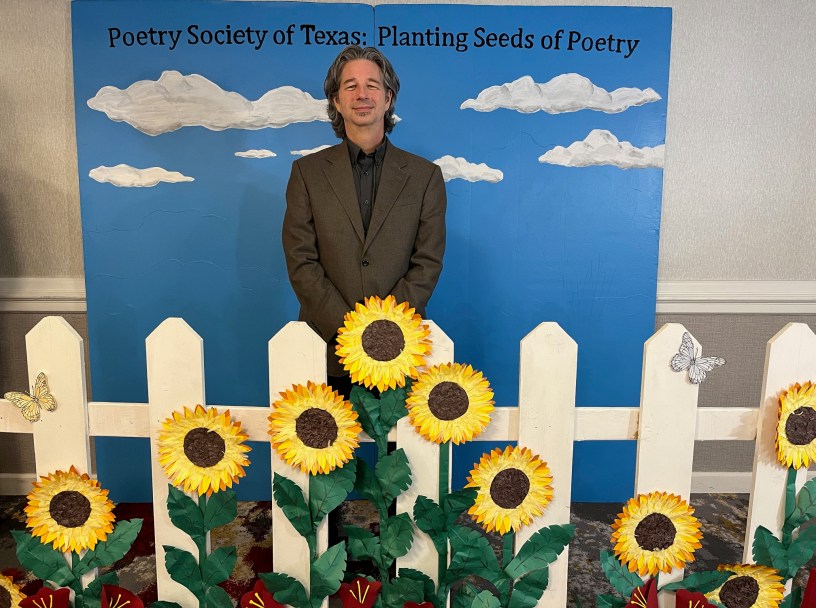
I was lucky enough to attend the Poetry Society of Texas Annual Awards Banquet again this year. It’s a lot of fun chatting with other Texas poets and hearing most of the wining poems being read. I was more than happy to take home three awards this year for my poems “ring” (that explores the symbolism of the wedding ring), “two towers twenty-three years” (about 9/11), and “the film” (about the movies, of course!) While 98% of the poems I send out to journals and contests were written in the last five years, I have a few still strong poems from my graduate days that I include. “The film” is one of those few poems. So happy to have it rewarded! It really reinforces the idea that there is an audience out there for all good art. Often you just have to find the right one.

A Quick Guide to Useful Books for the Active Poet

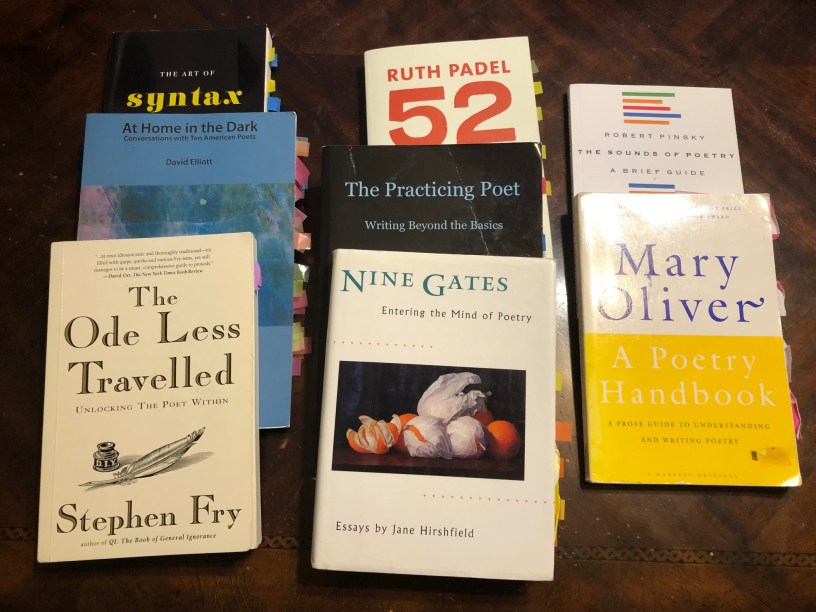
Having read several books recently on the writing of poetry, I thought it would be good to provide a quick guide on some of those I found the most useful.

A Poetry Handbook (by Mary Oliver) – This is a great overview of poetry writing. I rarely reread books, but I’ve reread portions of this one.

The Ode Less Travelled (by Stephen Fry) – The best book I’ve read on forms. It’s so well-written. Fry, of course, is a professional actor, but as he refers to himself, an amateur poet. Doesn’t matter. His writing is spot-on and highly practical.

Nine Gates (by Jane Hirshfield)  – How to describe this book? These nine essays cover a lot of ground in the poetry craft, but what Hirshfield does best is to deal with some of the more mystical questions in poetry.

The Sounds of Poetry (by Robert Pinsky) – What it sounds like. Really helps you understand how sound goes to work in a poem. Mary Oliver’s book touches on this too.

The Art of Syntax (by Elllen Bryant Voigt) – This deals specifically with the tension between a poem’s syntax and its form. An illuminating perspective that I don’t think all poets consider in their writing.

The Practicing Poet (by Diane Lockward) – To describe this book as a series of prompts with examples and discussion doesn’t seem to do it justice. I worked through the entire book over the course of a year and found it very fruitful for my own writing. My published poem “Coiled Drum Bides in Stillness” (Interpreter’s House, 2020) emerged from one of these prompts.

At Home in the Dark (by David Elliott) – Elliott interviews 10 prominent poets. A terrific read on the topics dear to poets. I want to find more books like this.

52 Ways of Look at a Poem (by Ruth Padel) – The introduction to this book is a top-notch and insightful summation of modern poetry. The book then takes you through 52 poems and dissects them. This is a really good book for understanding how successful poems work.

Enjoy!